How ciniq works.
Three ideas carry the whole app: a reading instead of a score, an audition instead of a commitment, and a card instead of a feed. Ten minutes with each and you know the app.
Two minutes of setup, once.
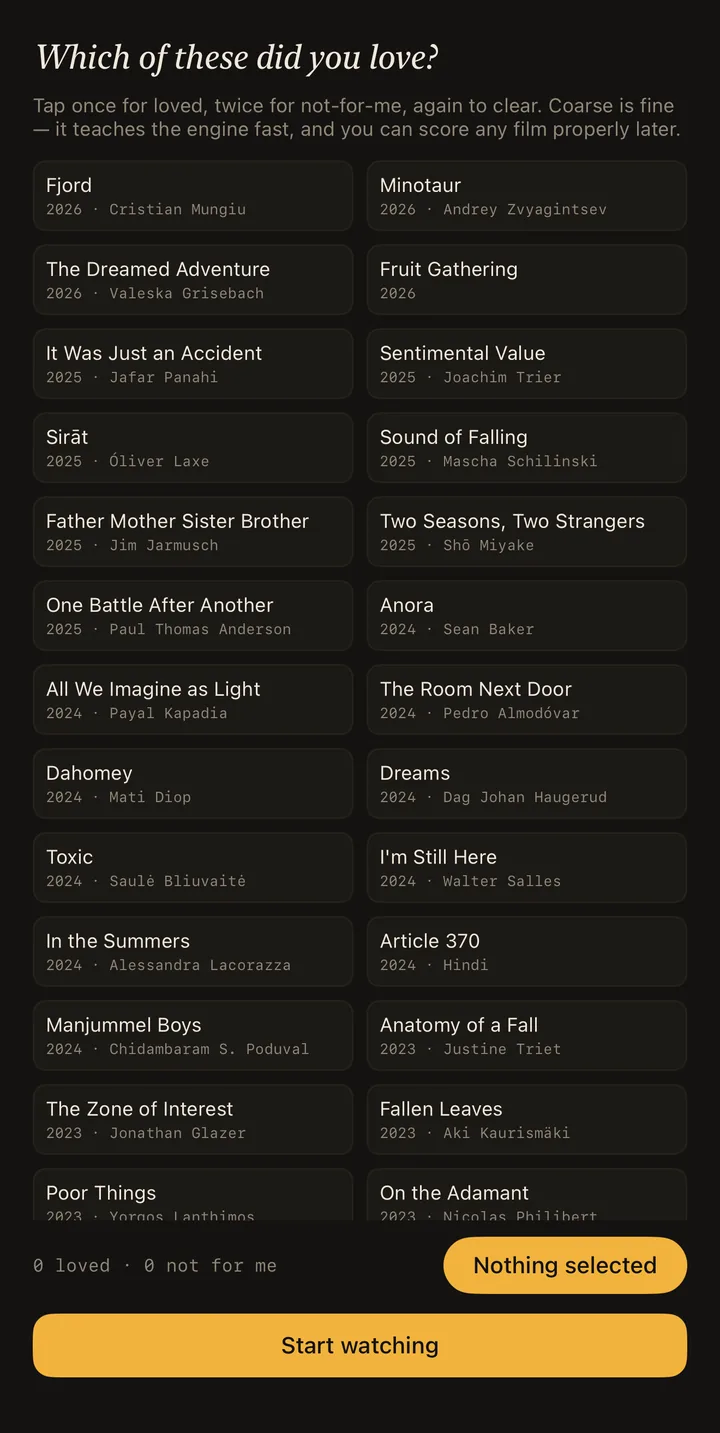
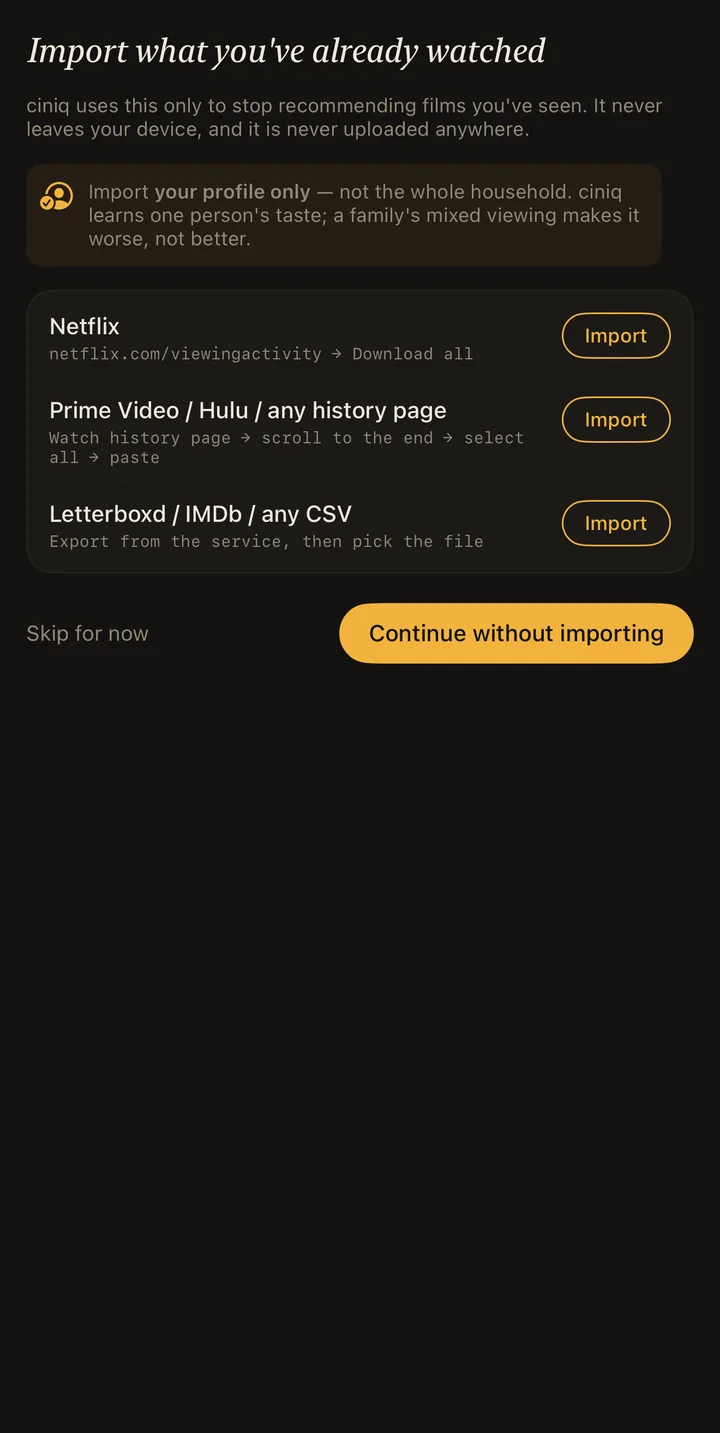
On first open, ciniq asks two things. First, which recent festival films you loved — tap once for loved, twice for not-for-me; coarse is fine, it just teaches the engine fast. Second, optionally, what you've already watched — Netflix, Prime, Letterboxd, IMDb, any CSV — used only to stop recommending films you've seen. Import your profile, not the household's: ciniq learns one person's taste.
Nothing here creates an account. Nothing leaves the device.
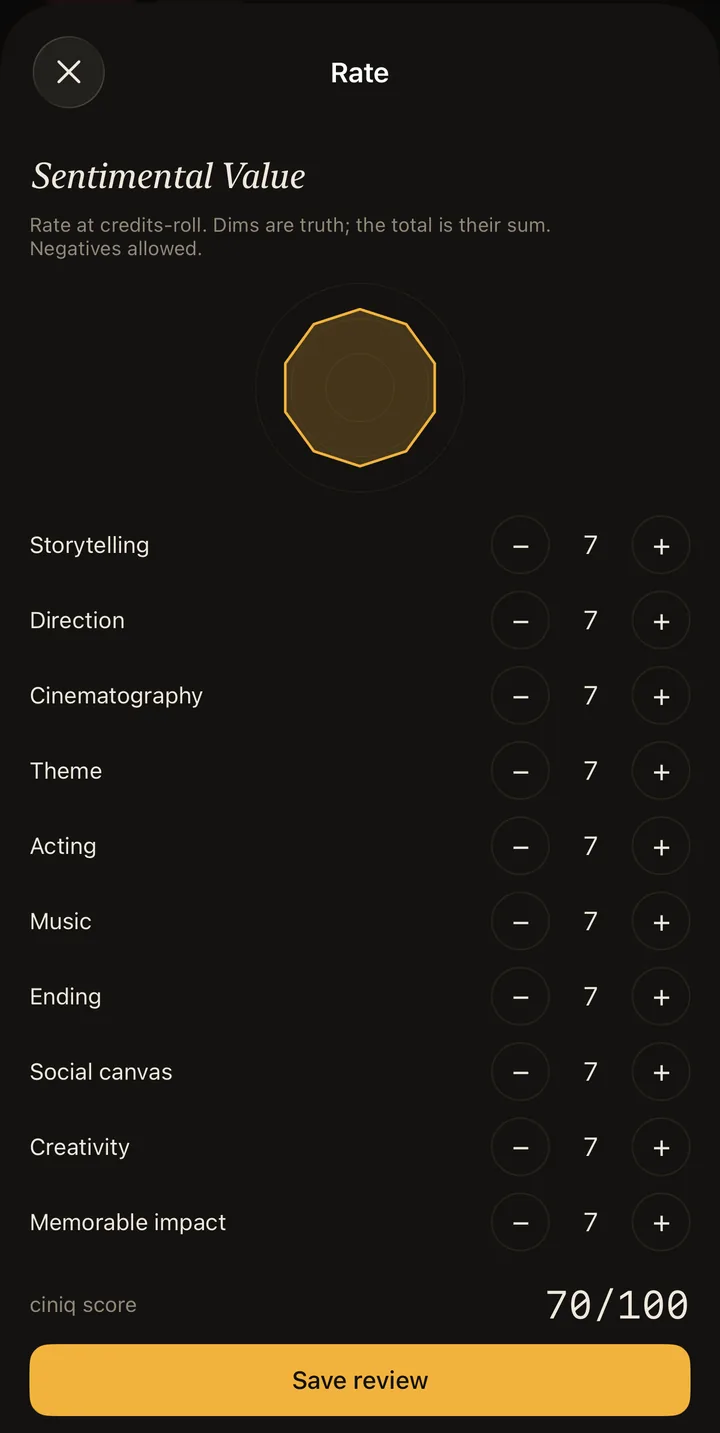
Ten dimensions become a shape.
When the credits roll, you don't give stars. You read the film across ten dimensions — storytelling, direction, cinematography, theme, acting, music, the ending, social canvas (the world it observes), creativity, and memorable impact — each from −10 to +10, negatives allowed. The dims are truth; the total is their sum.
Two films can share a total and be nothing alike — the shape is the point, and it's what the engine learns your taste from.
Every film gets ten minutes.
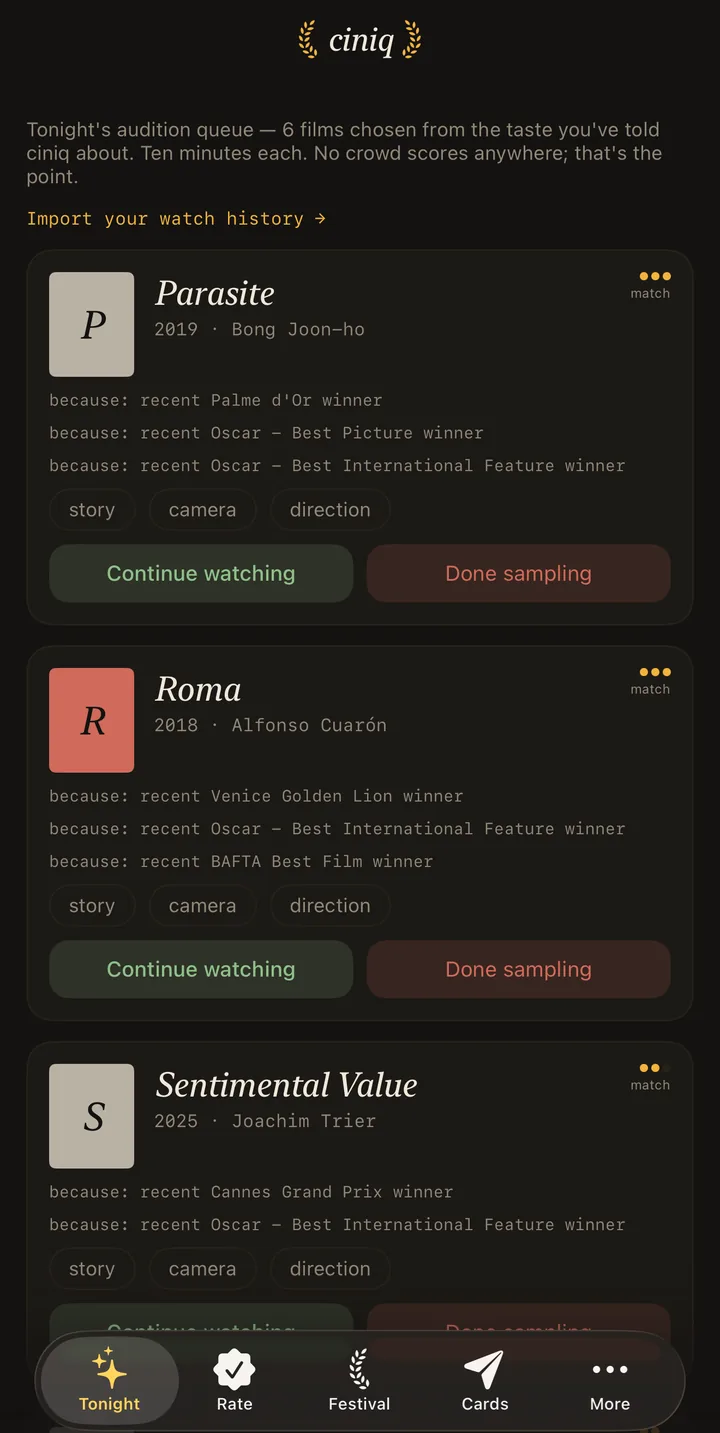
Tonight's queue picks a handful of films from the taste you've told ciniq about, and each pick shows its because — a recent Palme d'Or, a Golden Lion, a director you've scored high. Give it ten minutes: Continue watching if it's working, Done sampling if it isn't. Either is a complete review — no guilt, no half-watched purgatory — and the engine learns as much from what you set down as from what you finish.
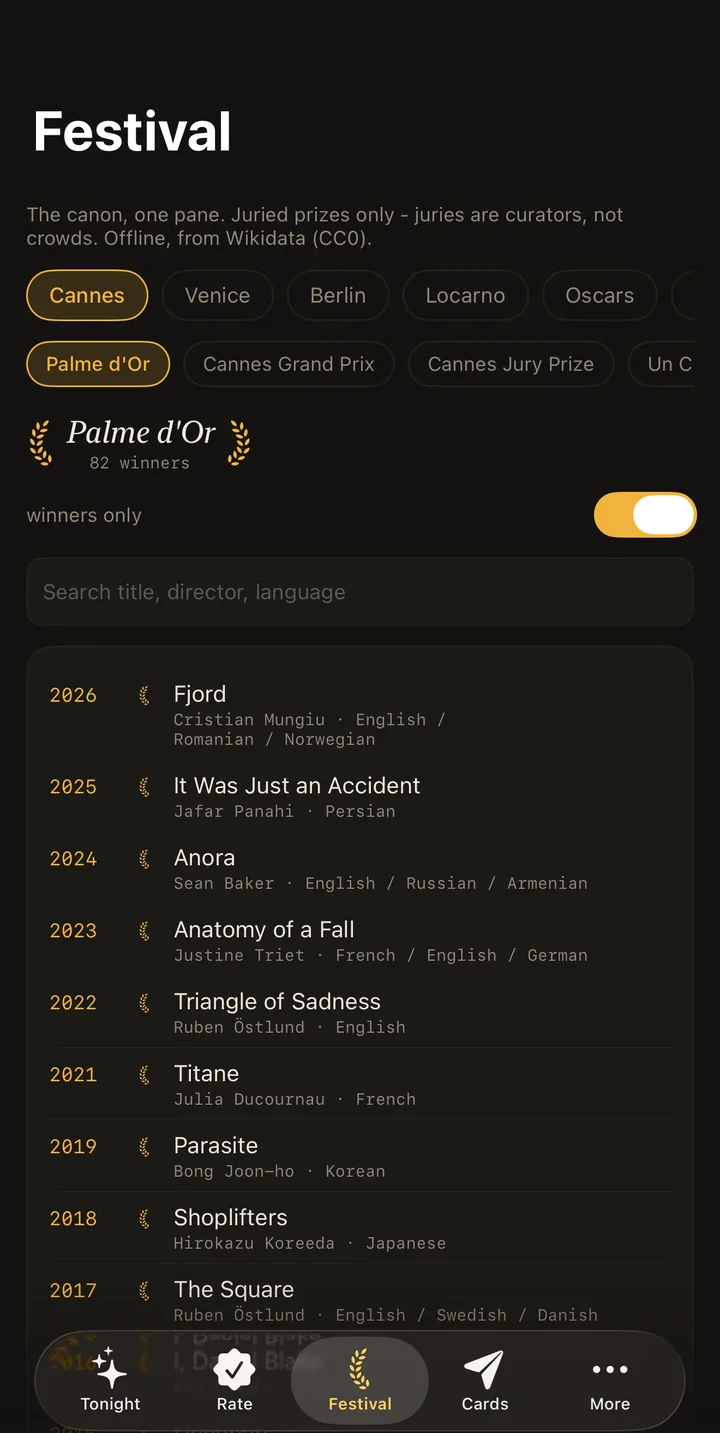
Behind the queue sits the canon: over four thousand films from Cannes, Venice, Berlin, Locarno and the Academy — juried prizes only, bundled with the app, browsable offline in the Festival pane.
Like a chess game, not a broadcast.
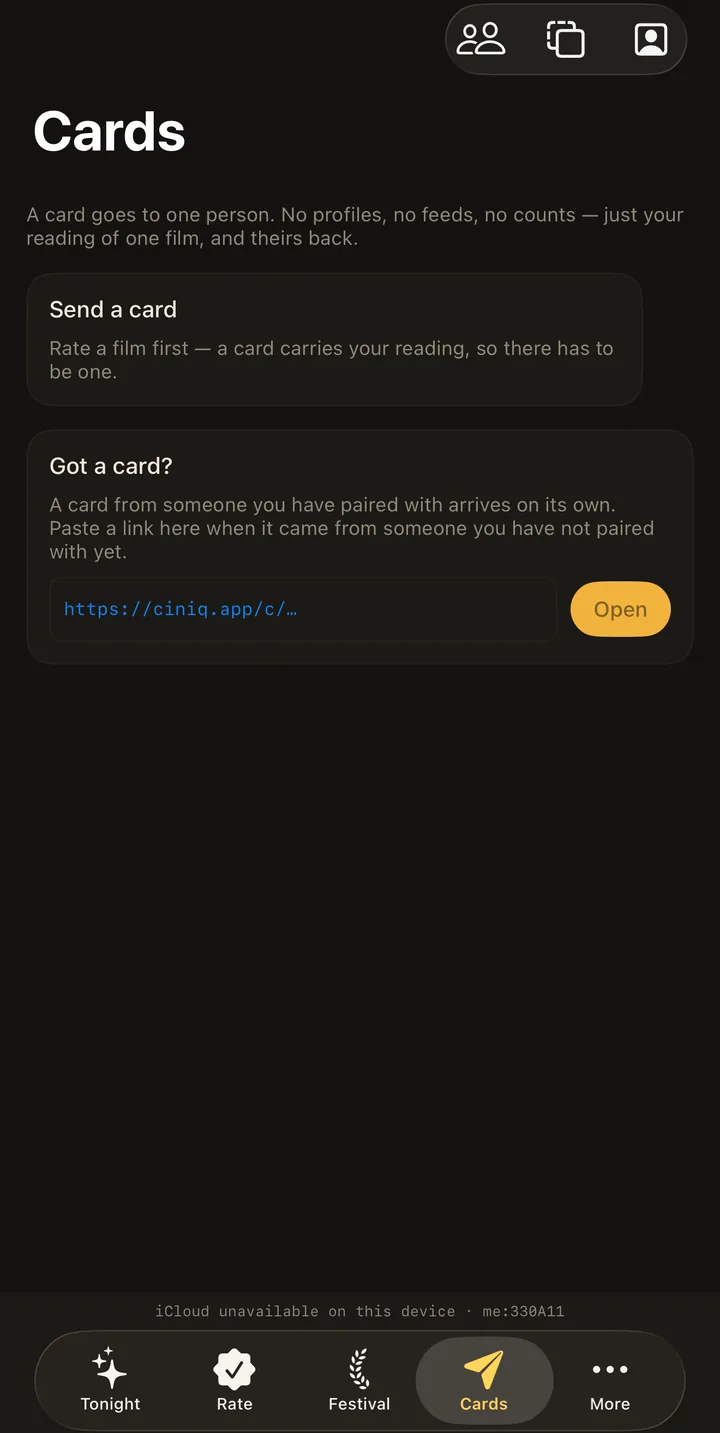
A card goes to one person: your reading of one film, and theirs back. Pair with a friend once and cards arrive on their own; a card from someone new is just a link you paste in. They score it blind — your numbers stay hidden until they've committed their own — then both readings are revealed and you see exactly where you split. One card at a time per friend, each answered before the next.
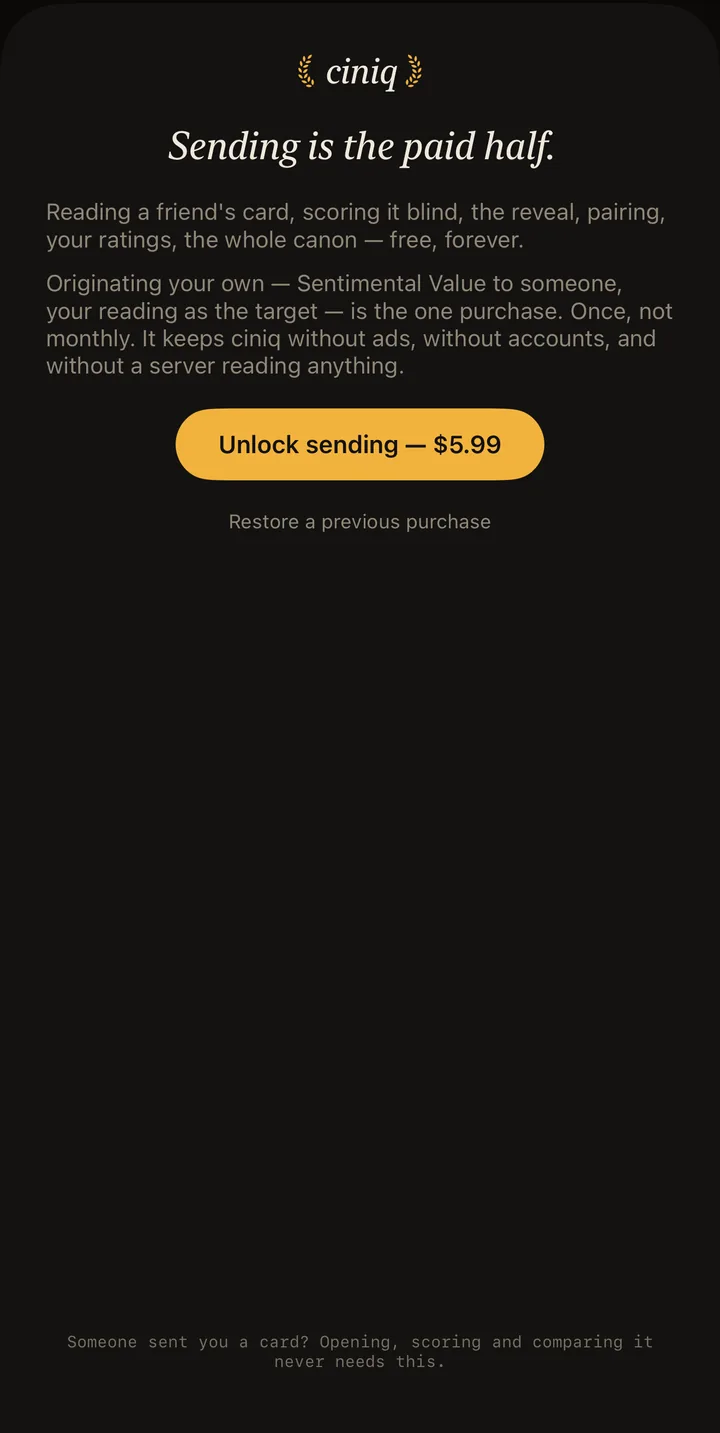
Receiving, scoring, comparing and pairing are free forever. Sending is the paid half — ciniq+, one purchase, $5.99, not monthly. It keeps ciniq without ads, without accounts, and without a server reading anything: the card travels as a link, everything riding after the “#”, which browsers never send anywhere.
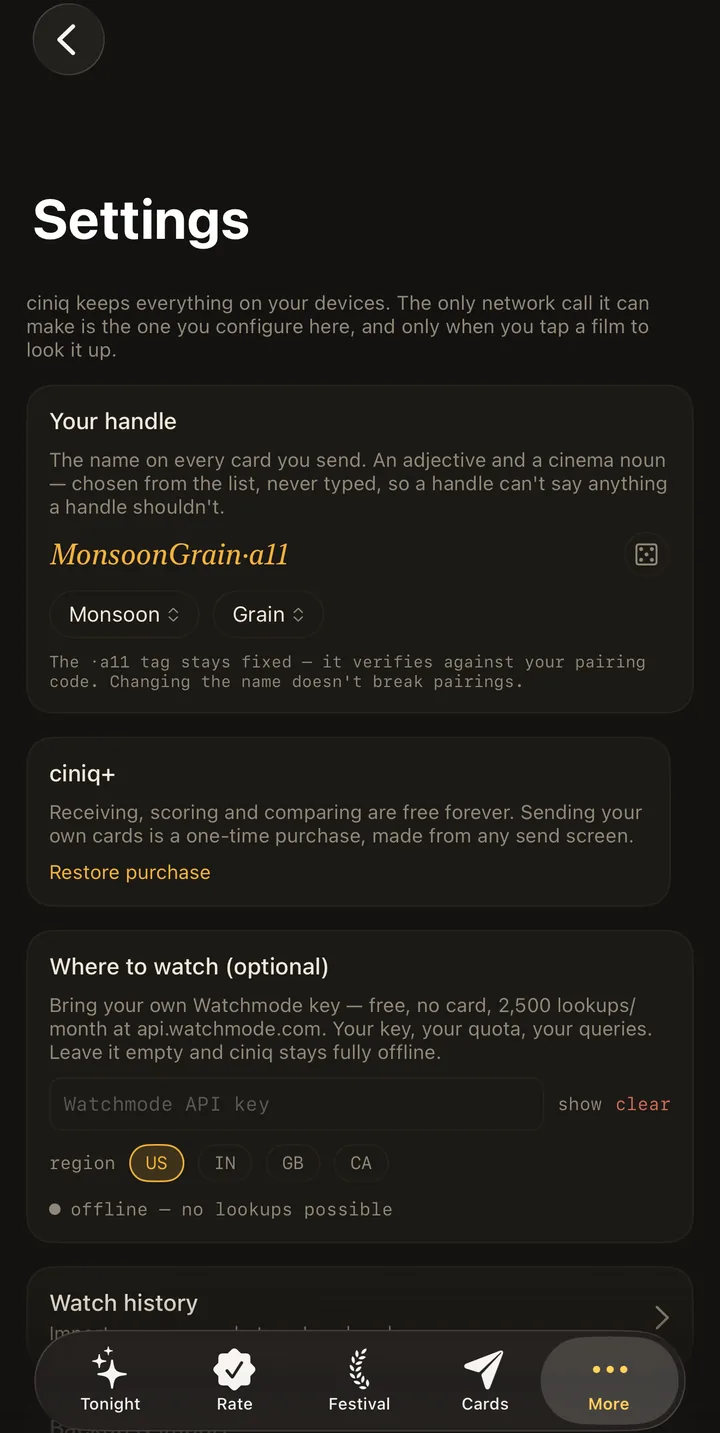
Your handle, and the one network call.
Your handle — the name on every card — is an adjective and a cinema noun chosen from a list, never typed, so a handle can't say anything a handle shouldn't. Change the words any time; the small tag after it stays fixed and verifies against your pairing, so renaming never breaks a friendship.
Where-to-watch is optional and bring-your-own: a free Watchmode key — your key, your quota, your queries. Leave it empty and ciniq stays fully offline; the only network call it can make is the one you configure here. Backup & import lives at the bottom — export everything, restore on another device.